Rogue
  .----------------.
 / .--------------. \
|  | -----        |  |
|  | |.@.+####    |  |
|  | |.!?|   #    |  |
|  | ----- --+--  |  |
|  |       |.>.|  |  |
|  |       -----  |  |
|  '--------------'  |
|  o             []  |
'--------.  .--------'
      ___|__|___
  ___/__________\___
 /[][][][][][][][] /
ASCII illustration
The dungeon that would not stay learned.
1980: university Unix release.
By Michael Toy, Glenn Wichman and Ken Arnold.
Rogue began with Michael Toy and Glenn Wichman at the University of California, Santa Cruz. Ken Arnold’s curses library made a dungeon drawn on a terminal practical; Arnold later joined the game’s development. Wichman’s account places a particular frustration at the centre of it: once an adventure had been solved, its surprises were gone. A freshly arranged dungeon let even its authors explore.
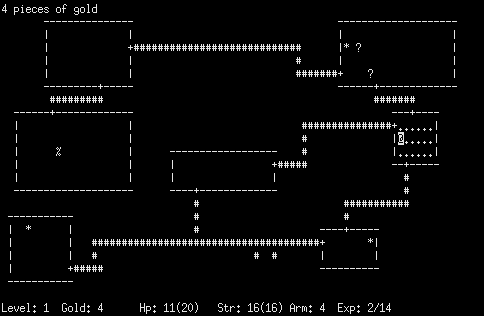
Rooms, corridors and monsters became a small alphabet. The player was an @. That abstraction left the important information exposed: distance, exits, obstacles and things that might kill you. Finding the Amulet of Yendor was only part of the journey. You still had to get back out.
Rogue brought its particular combination of generated levels, limited supplies, uncertain items and permanent death to a wide Unix audience. It did not invent computer dungeon exploration. Its lasting achievement was making a new expedition out of the same small set of rules.
The BSD screenshot below was taken in 2021. It shows a later version of the game, not an original 1980 session.
Sources
Glenn Wichman: A Brief History of Rogue